
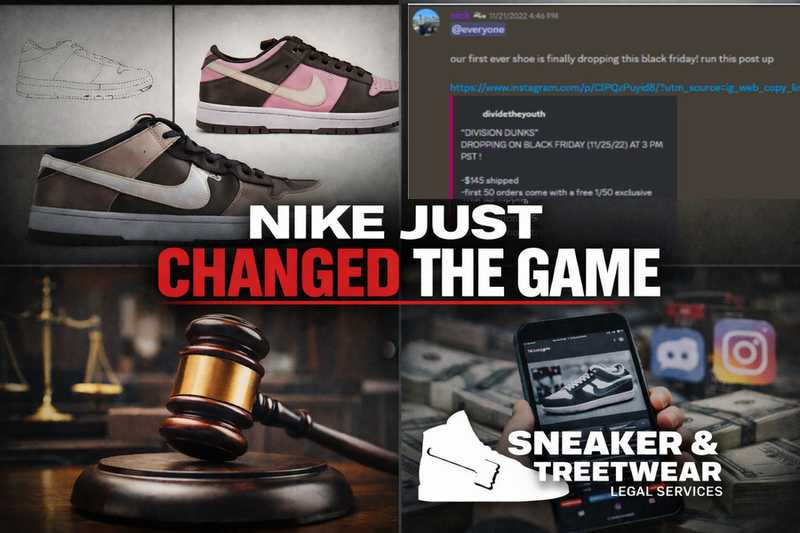
The sneaker industry has always lived at the intersection of culture and commerce. What this recent $11 million jury verdict makes clear is that it also sits squarely within the crosshairs of aggressive intellectual property enforcement.
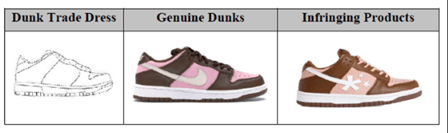
A federal jury in California awarded Nike $11 million in damages against influencer Nicholas Tuinenburg and his brand Divide the Youth for counterfeiting, trademark infringement, and trade dress infringement tied to the promotion and sale of counterfeit ‘rep’ or replica Nike sneakers and lookalike Dunk sneakers sold by his brand as ‘Division Dunks.’
This case is not just about counterfeits. It is about how modern sneaker businesses actually operate today and the legal exposure that comes with it. Social media. Affiliate links. Discord channels. Community-driven commerce.
Trade Dress Takes Off the Swoosh and Other Brand Logos
One of the most important takeaways is not about logos. It is about shape.
Trade Dress protects the overall commercial image or look and feel of a product, including its design, packaging and configuration. For sneakers this does not always mean the entire design. The shape and design of panels, midsoles, sole, stitching and other unique design features are what brands claim for protection in trade dress registrations.
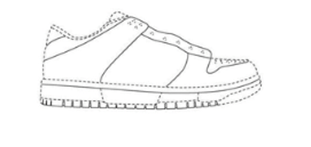
USPTO Reg. No. 3711305
For Nike’s Dunk Trade Dress Registration above, the mark consists of “the design of the stitching on the exterior of the shoe, the design of the material panels that form the exterior body of the shoe, the design of the wavy panel on top of the shoe that encompasses the eyelets for the shoe laces, the design of the vertical ridge pattern on the sides of the sole of the shoe, and the relative position of these elements to each other. The broken lines show the position of the mark and are not claimed as part of the mark.”
The jury found liability not only for use of Nike word marks and logos, but also for infringement of Nike’s Dunk trade dress. In other words, the overall look and feel of the sneaker design alone was enough, even without the swoosh and with third-party branding.
That really matters for anyone operating in this space.
You cannot assume that removing a Swoosh or swapping branding makes a design legally safe. If the product still captures the recognizable elements of a protected silhouette, you are in trade dress territory. Many brands, including Nike, now protect their sneaker silhouette designs with trade dress registrations. Nike has registrations for all Air Jordan models 1- 13 (except the AJ10) and just applied for the trade dress of the Air Jordan 14 earlier this week.
For sneaker brands and customizers, this is the line between inspiration and liability.
Influencers Are No Longer Just Marketing
Historically, influencers viewed themselves as promoters. That distinction is collapsing.
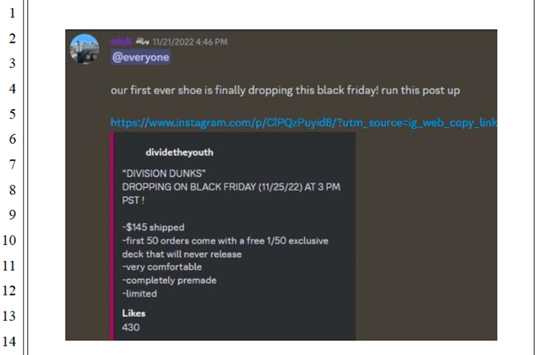
In this case, the influencer did more than post content. The allegations and findings centered on a broader ecosystem that included:
- Direct promotion of replica products
- Providing purchasing guidance
- Using affiliate links and discount codes
- Driving traffic to third-party sellers
That combination was enough to support findings of both direct and contributory liability. This is a fundamental shift.
If you are monetizing access, facilitating transactions, or acting as a bridge between consumers and infringing products, you are not just “marketing.” You are potentially part of the distribution chain.
$11 Million: The Scale of Damages Should Get Your Attention
The defendants argued that their actual profits were a fraction of the damages sought. The defendant allegedly sold 384 ‘Division Dunk’ sneakers for a total of around $56,000. The jury did not care. Nike requested $18 million in damages.
Nike secured:
- $8 million in statutory damages under the Lanham Act
- $3 million as additional punitive damages based on willful conduct
This is the enforcement model major brands are increasingly using. They are not just trying to stop activity. They are using litigation and statutory damages based on the Lanham Act for registered trade dress and counterfeiting to send a message.
Even relatively small operations can face outsized exposure when willfulness and counterfeiting are on the table. Punitive damages and treble (3x) damages are serious
“But It’s Custom” Is Not a Defense
There is a persistent myth in sneaker culture that customization creates a legal safe harbor. It does not.
If the underlying product or design infringes protected trade dress or trademarks, adding new elements does not cure the issue, especially if you are intending to resell them. In many cases, it can make things worse by demonstrating intentional modification of a known product and can be a material alteration.
This is especially true where:
- The base silhouette is recognizable
- The marketing references the original brand
- The product is sold commercially, not just modified for personal use
A custom for personal use or use in a form of creative artistic expression may have additional defenses that could permit the use, but saying a bootleg is a custom will not usually work. The legal analysis does not stop at creativity. It starts with source identification and consumer confusion.
Saying a sneaker design was ‘inspired by’ a sneaker is not a great defense either. Calling them ‘reps’ or replicas really only hurts your case as may be used to show your intent was to copy and replicate a registered trade dress or design. The court would look at the similarities between the two and your intent to piggyback on that sneaker silhouette/ brands success, in addition to looking at any actual or potential consumer confusion.
The Platform Layer Is Now in Play
Another key aspect of this case is how the defendants sales activity was structured.
The use of Discord servers, shipping agents, and affiliate networks reflects how the modern resale and replica ecosystem actually operates. The court and jury were willing to engage with that reality.
That should put every platform-adjacent business on notice.
If your business model involves:
- Aggregating sellers
- Facilitating transactions
- Curating or promoting products
You need to evaluate exposure not just for direct infringement, but for contributory liability as well.
What This Means for Sneaker Brands and Creators
This case is not an outlier. It is a roadmap. Brands have registered trademarks, copyrights and patents and obtaining those registrations provides them with certain benefits, including statutory damages. This is why Sneaker Legal encourages brands to apply and register their trademarks and intellectual property the same way the larger brands do.
For independent brands, customizers, and influencers, there are a few clear takeaways:
First, product design needs to be evaluated through a trade dress lens, not just a logo analysis. Many brands are using trade dress to protect older and new designs.
Second, marketing activity can create liability. The way you sell is just as important as what you sell. Your ads and exposure are quantified with social media use that can reach users on a global scale.
Third, scale is not protection. Smaller operators are increasingly being targeted to set precedent.
Fourth, documentation matters. Intent, knowledge, and willfulness are often inferred from how a business operates, both, publicly and behind the scenes with its designs, research and planning.
The Bottom Line
The sneaker industry has matured. The law has caught up.
What used to be dismissed as “rep culture” or “bootleg energy” is now being litigated with serious and expensive consequences.
If you are building in this space, whether as a brand, a creator, or a platform, you need to treat intellectual property as core infrastructure, not an afterthought.
At this level, it is not just about protecting your brand, it is about making sure you and your business survives and sets up the proper structures for future success.
WORKING WITH SNEAKER LEGAL ON TRADE DRESS AND COUNTERFEITING EXPOSURE
Enforcement in the sneaker space has evolved. Liability is no longer confined to factories or overseas sellers. It now reaches anyone participating in the commercial chain, including brands, customizers, content creators, and operators of digital communities.
Sneaker Legal represents clients in this environment with a practical understanding of both the law and the culture driving these businesses. Our focus is not theoretical compliance. It is real world risk tied to how products are designed, marketed, and sold.
Our work includes:
- Evaluating product designs against existing silhouettes and protected trade dress
- Advising on content strategy, partnerships, and monetization models that can trigger liability
- Structuring branding and product positioning to minimize confusion and enforcement risk
- Marketing, sales, packaging and disclaimer usage
- Guiding clients through disputes, from early stage exposure analysis through litigation
Our industry specific experience will help you before problems occur. We approach these issues the same way courts do. The analysis turns on what consumers see, how products are presented in the market, and whether the overall commercial impression crosses the line. That is where most brands get into trouble.
The goal is not just to respond when issues arise. It is to build with these risks in mind from day one so the business can scale without becoming a target and so you can sleep at night with no worries.
LEGAL DISCLAIMER
The content on this blog is for informational and educational purposes only and does not constitute legal advice. It’s meant to help creators, designers, and brands better understand the legal side of the sneaker, fashion, and streetwear industries. Not to provide advice on any specific situation.
Reading this post, commenting on it, or contacting Sneaker & Streetwear Legal Services through this website does not create an attorney–client relationship. I am an attorney, but I am not your attorney, until we both sign the Sneaker Legal Attorney Client Engagement Agreement.
Laws and regulations change, and how they apply depends on your unique facts and circumstances. Before making any business or legal decisions, you should consult with a qualified attorney licensed in your jurisdiction. Sneaker & Streetwear Legal Services makes no guarantees about the completeness, accuracy, or timeliness of the information provided here. Any opinions expressed are those of the author and don’t necessarily reflect the views of the firm or its clients.
If you’re looking for legal guidance tailored to your brand or creative business, reach out to us directly.


